
Interviews
Josef Schuster on the IPOX® ETFs (TD Ameritrade)
Josef Schuster on the IPOX® ETFs (TD Ameritrade)

News and updates from IPOX®, including media mentions, interviews, research and press releases.
Josef Schuster on the IPOX® ETFs (TD Ameritrade)
Not always, but that’s certainly the case for stock prices of the companies that saw the financial upside of the pandemic. Once called the “pandemic winners,” some companies have seen their share prices slide this year, with the likes of Zoom , Peloton , Moderna and Roku all down more than 20 percent so far. That’s part of an underlying shift of investors looking for profits rather than growth potential. “There’s a really big recalibration going on in terms of risk and returns and valuation, and I think it’s a good thing,” said Josef Schuster , founder of IPOX® Schuster , which provides financial services related to new listings. For the pandemic darlings like Zoom and Peloton that saw their stock price skyrocket—thanks to social distancing and the work-from-home environment—their performance this year is the result of both the COVID-19 situation changing, and investors shifting away from growth stories, according to Schuster. Zoom, Peloton, Moderna, and DocuSign were among the Nasdaq 100’s best-performing stocks of 2020, according to MarketWatch . As long as those companies are trading, they’re going to be under a lot of pressure to produce “really, really strong results,” Schuster said. When some of those companies, such as Peloton, went public, the popular mindset was that a company could go public with 20x sales as long as it had a growth story, Schuster said. Now, those same companies are under pressure to record strong results and will see their stock price decline if they don’t beat analyst expectations well enough, he said. Schuster pointed to DocuSign as an example. The e-signing company, which benefited from the pandemic-induced reliance on e-signatures, saw its stock price take a hit last month after it reported fourth-quarter guidance that didn’t live up to analyst estimates. Peloton’s stock price also fell after CNBC reported that the company was pausing production on its bike after demand waned. The macroeconomic environment hasn’t helped either. The most recent couple of weeks have been wild for the market, with the S&P 500 closing down for the fourth straight week. Part of that’s been driven by inflation concerns, and even big names like Tesla and Netflix have seen their stock prices negatively affected. With the prospect of interesting rate hikes looming, the market is pricing that in, according to Patrick Healey , founder of Caliber Financial Partners . The equity markets tend to exaggerate both the upside and the downside, he said. Many growth stocks got overheated last year, and now we’re seeing an overcorrection to the downside. And it was inevitable, given how high some stocks were trading, Healey said. “I think some of the highflyers that were trading at really insane price to earnings multiples have gotten beaten down, and they should’ve,” Healey said. But with “pandemic fatigue,” many investors have moved away from the “stay at home” type companies that saw their share price skyrocket in 2020 and 2021. “I think people are not focused on the ‘stay at home trade,’ if you will, because I think that was largely market-sentiment based rather than fundamentals-based,” Healey said.
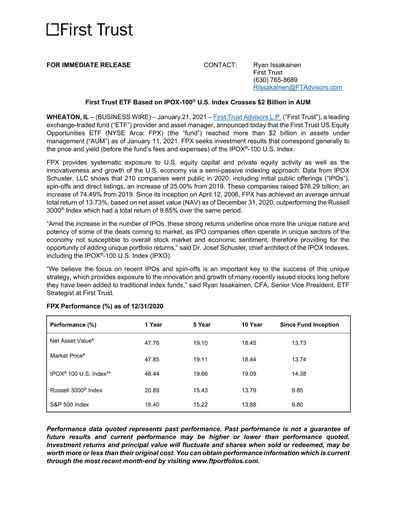
First Trust ETF (FPX) Based on IPOX®-100® U.S. Index (IPXO) Crosses $2 Billion in AUM

Josef Schuster on the Airbnb IPO (Yahoo Finance)
Factor investing has become increasingly popular in recent years. Institutional investors have been shifting to more transparent and systematic factor approaches where they can clearly see the exposures which they are carrying. We quantify the factor exposures of the IPOX® 100 U.S. index portfolio using a combination of time- series correlations and weight-based exposures. We explore the portfolio’s sensitivity to market beta, to GICS® sectors, and to fundamental factors such as value, quality, growth, small cap, momentum, low volatility, and high dividend (yield). We find some evidence of industry factors, and the presence of mild growth, momentum, and size exposures. We do not find evidence for beta (market risk) tilts. In aggregate, about 2/5 of the portfolio’s outcome can be explained using industry and fundamental factors. The findings suggest that IPOs as measured by IPOX® carry unique factor footprints that cannot be well captured using traditional factor exposures.

U.S. IPO market expected to see more unicorns: IPOX® Schuster (BNN Bloomberg)
Factor investing has become increasingly popular in recent years. Institutional investors have been shifting to more transparent and systematic factor approaches where they can clearly see the exposures which they are carrying. We quantify the factor exposures of the IPOX® 100 U.S. index portfolio using a combination of time-series correlations and weight-based exposures. We explore the portfolio’s sensitivity to market beta, to GICS® sectors, and to fundamental factors such as value, quality, growth, small cap, momentum, low volatility and high dividend (yield). We find some evidence of industry factors, and the presence of mild growth, momentum and size exposures. We do not find evidence for beta (market risk) tilts. In aggregate, about 1/3 of the portfolio’s outcome can be explained using industry and fundamental factors. The findings suggest that IPOs as measured by IPOX® carry unique factor footprints that cannot be well captured using traditional factor exposures.
Global issuing activity in Initial Public Offerings (IPOs) has picked up, associated with a large increase in filings of well-branded U.S. companies in a broad range of industries. This is being driving by the favorable performance of recently issued IPOs and fundamental shifts in the profile of U.S. IPO companies following Sarbanes-Oxley, safeguarding higher quality listing standards and severe regulatory scrutiny towards IPO companies. As a result, a large number of older and more mature companies have been going public.
We apply a sector-based approach to companies going public in the six largest Continental European markets and Sweden during a period characterized by dramatic change. For a sample of 973 IPOs during 1988 and 1998, there is considerable underpricing which is time-varying and related to company characteristics. Much of the large amounts of “money left on the table” is due to privatization issues. For the sample as a whole, IPOs did not underperform in the long-run. Over shorter measurement horizons, we find overperformance. IPO performance is sensitive to market condition at the time of going public and IPO issuing characteristic. The favourable performance for the sample as a whole is driven by New Economy IPOs accounting for 28 percent of the sample. The pervasiveness of the outperformance of New Economy IPOs sheds light on the drivers behind the dramatic shift in industry composition of European IPOs in favor of New Economy IPOs during the “Internet Bubble”.