
Chicago / Edinburgh
LATEST FROM IPOX®

News

News and updates from IPOX®, including media mentions, interviews, research and press releases.

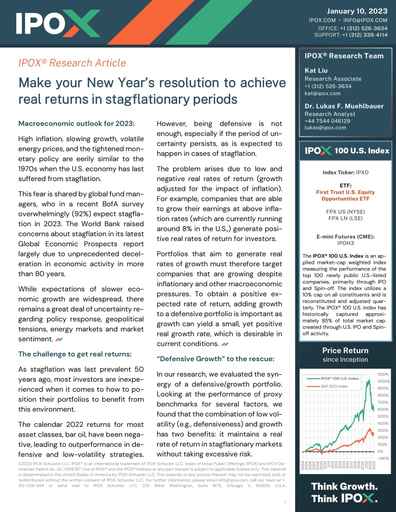
IPOX® Research: Achieving real returns in stagflationary periods

IPOX® Research: Achieving real returns in stagflationary periods

The IPOX® Research Team has written a new article discussing the fear of stagflation in 2023 and the challenges that investors face in positioning their portfolios to benefit from this economic environment. We suggest a "defensive growth" portfolio as a solution and highlight the IPOX® 100 U.S. Index as a logical choice for this type of exposure, offering majority defensive growth exposure that outperforms in stagflationary markets, high liquidity and a unique part of the capital markets of resilient companies with the potential to generate positive real growth rates.
The IPOX® SPAC Research - U.S. SPAC Market Review and Outlook Q1 2022

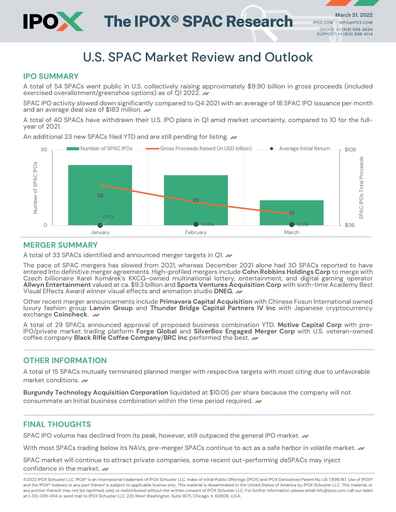
The IPOX® SPAC Research - U.S. SPAC Market Review and Outlook Q1 2022

A total of 54 SPACs went public in U.S. collectively raising approximately $9.90 billion in gross proceeds (included exercised overallotment/greenshoe options) as of Q1 2022. SPAC IPO activity slowed down significantly compared to Q4 2021 with an average of 18 SPAC IPO issuance per month and an average deal size of $183 million.

The IPOX® SPAC Research – U.S. SPAC Market Review and Outlook, FY 2021

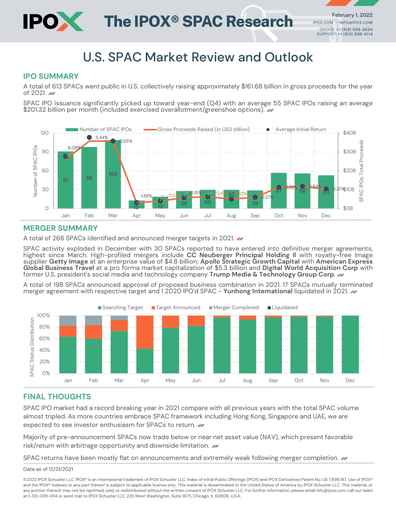
The IPOX® SPAC Research – U.S. SPAC Market Review and Outlook, FY 2021

A total of 613 SPACs went public in U.S. collectively raising approximately $161.68 billion in gross proceeds for the year of 2021. SPAC IPO issuance significantly picked up toward year-end (Q4) with an average 55 SPAC IPOs raising an average $201.32 billion per month (included exercised overallotment/greenshoe options).

Factor Exposures for the IPOX® Portfolio 2020

Factor investing has become increasingly popular in recent years. Institutional investors have been shifting to more transparent and systematic factor approaches where they can clearly see the exposures which they are carrying. We quantify the factor exposures of the IPOX® 100 U.S. index portfolio using a combination of time- series correlations and weight-based exposures. We explore the portfolio’s sensitivity to market beta, to GICS® sectors, and to fundamental factors such as value, quality, growth, small cap, momentum, low volatility, and high dividend (yield). We find some evidence of industry factors, and the presence of mild growth, momentum, and size exposures. We do not find evidence for beta (market risk) tilts. In aggregate, about 2/5 of the portfolio’s outcome can be explained using industry and fundamental factors. The findings suggest that IPOs as measured by IPOX® carry unique factor footprints that cannot be well captured using traditional factor exposures.

Factor Exposures for the IPOX® Portfolio 2019

Factor investing has become increasingly popular in recent years. Institutional investors have been shifting to more transparent and systematic factor approaches where they can clearly see the exposures which they are carrying. We quantify the factor exposures of the IPOX® 100 U.S. index portfolio using a combination of time-series correlations and weight-based exposures. We explore the portfolio’s sensitivity to market beta, to GICS® sectors, and to fundamental factors such as value, quality, growth, small cap, momentum, low volatility and high dividend (yield). We find some evidence of industry factors, and the presence of mild growth, momentum and size exposures. We do not find evidence for beta (market risk) tilts. In aggregate, about 1/3 of the portfolio’s outcome can be explained using industry and fundamental factors. The findings suggest that IPOs as measured by IPOX® carry unique factor footprints that cannot be well captured using traditional factor exposures.

Navigating the IPO Market with IPOX® IPO Indexes

Global issuing activity in Initial Public Offerings (IPOs) has picked up, associated with a large increase in filings of well-branded U.S. companies in a broad range of industries. This is being driving by the favorable performance of recently issued IPOs and fundamental shifts in the profile of U.S. IPO companies following Sarbanes-Oxley, safeguarding higher quality listing standards and severe regulatory scrutiny towards IPO companies. As a result, a large number of older and more mature companies have been going public.

The Cross-Section of European IPO Returns

We apply a sector-based approach to companies going public in the six largest Continental European markets and Sweden during a period characterized by dramatic change. For a sample of 973 IPOs during 1988 and 1998, there is considerable underpricing which is time-varying and related to company characteristics. Much of the large amounts of “money left on the table” is due to privatization issues. For the sample as a whole, IPOs did not underperform in the long-run. Over shorter measurement horizons, we find overperformance. IPO performance is sensitive to market condition at the time of going public and IPO issuing characteristic. The favourable performance for the sample as a whole is driven by New Economy IPOs accounting for 28 percent of the sample. The pervasiveness of the outperformance of New Economy IPOs sheds light on the drivers behind the dramatic shift in industry composition of European IPOs in favor of New Economy IPOs during the “Internet Bubble”.

The Case for Indexing Chinese IPOs

We apply an event study methodology to the performance of China domiciled companies going public in Hong Kong and abroad between 1995 and 2008 and study the case for indexing the Chinese IPO sector with IPOX®, an innovative IPO indexing solution. For a sample of 373 Chinese IPOs, we find substantial initial returns. IPO performance is sensitive to the market condition at the time of going public and IPO issuing characteristics. IPO underperformance appears to be a short to medium term phenomenon and linked to the initial IPO characteristics such as the market condition at the time of going public, initial return, size and listing exchange. In the long-run, we do not find that Chinese IPOs underperform. This is driven by the return of few companies which describes the essence of the IPO market. We underline the case for indexing the performance of this dynamic sector by using IPOX®, which has been able to competitively capture the performance of IPOs within a semi-passive and scalable index approach. This study comes at an important juncture in Asian Equity Capital Markets Activity at a time when applications for listings of Chinese domiciled companies in Hong Kong are at an all-time high, promising a potentially large number of new entrants into the IPO sector, generally perceived to be a true proxy for China-linked growth and innovation.

IPOs: Insights from Seven European Countries

We perform a comparative country-by-country study of companies going public in the six largest Continental European markets and Sweden during 1988 and 1998, a time period characterized by IPO activity in a broad set of industries. By applying a common research methodology, we find broad similarity in the overall and cross-sectional initial pricing and long-run performance patterns. Positive long-run IPO performance is a function of a countriesí ability to attract ìNew Economyî IPOs. This helps to shed some light on the rational behind the frantic efforts made be individual European Stock Exchanges to establish ìNew Marketî segments during the late 1990s.

THE IPOX® NEWSLETTERS

Stay ahead of the next listing.

Research and insight from the global new listings market.

Explore our newsletters